
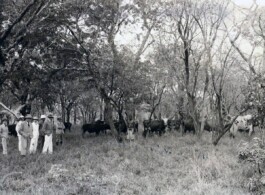


The line of research examines the Portuguese colonial policies towards pastoralist populations in Angola and Mozambique, investigating the strategies used by colonial administrators to transform their way of life and commercial practices, with the aim of transforming pastoralists from allegedly irrational and anti-economic actors (accumulating cattle for prestige and other social purposes) into 'progressive' or 'evolved' farmers and market-oriented entrepreneurs.
The research also examines how pastoralist populations in both sites have responded to such interventions and impositions, by evading and/or resisting the policies, or by accepting and even using them to their advantage. The research analyses these historical processes in both sites, using and developing novel concepts and perspectives derived from global history, particularly that of commodity frontiers, which place African cattle in a global context and show the limits of global circulation histories for understanding global processes.
It is a pioneering comparative study of an under-studied subject within an under-studied colonial empire, revealing whether and to what extent Portuguese cattle policies differed from those of other colonial imperial powers, and highlighting the different perspectives between and within the Portuguese colonies due to different socio-economic, environmental and (geo)political conditions, as well as different regional networks of expertise and inter-imperial learning, influence and political and economic constraints.


The line of research examines the Portuguese colonial policies towards pastoralist populations in Angola and Mozambique, investigating the strategies used by colonial administrators to transform their way of life and commercial practices, with the aim of transforming pastoralists from allegedly irrational and anti-economic actors (accumulating cattle for prestige and other social purposes) into 'progressive' or 'evolved' farmers and market-oriented entrepreneurs.
The research also examines how pastoralist populations in both sites have responded to such interventions and impositions, by evading and/or resisting the policies, or by accepting and even using them to their advantage. The research analyses these historical processes in both sites, using and developing novel concepts and perspectives derived from global history, particularly that of commodity frontiers, which place African cattle in a global context and show the limits of global circulation histories for understanding global processes.
It is a pioneering comparative study of an under-studied subject within an under-studied colonial empire, revealing whether and to what extent Portuguese cattle policies differed from those of other colonial imperial powers, and highlighting the different perspectives between and within the Portuguese colonies due to different socio-economic, environmental and (geo)political conditions, as well as different regional networks of expertise and inter-imperial learning, influence and political and economic constraints.


This website is part of and supported by the ERC Starting Grant CATTLEFRONTIERS, Grant No. 101076565 funded by the European Union.
Views and opinions expressed are however those of the author(s) only and do not necessarily reflect those of the European Union or the European Research Council Executive Agency. Neither the European Union nor the granting authority can be held responsible for them.
This website is created by: Kasper Jacek, using Lay Theme, Lora by Cyreal & Archivo Black by Omnibus-Type, licensed under Open Font License.
If nothing else is stated all material on this website is owned by the CATTLEFRONTIERS. Any archival material is used with the permission of the archives. For a complete list of copyrights for the archival material used on this website see Copyright – please contact us for permission to use any of the material on this website.
We don't store any personal data on this website.


This website is part of and supported by the ERC Starting Grant CATTLEFRONTIERS, Grant No. 101076565 funded by the European Union.
Views and opinions expressed are however those of the author(s) only and do not necessarily reflect those of the European Union or the European Research Council Executive Agency. Neither the European Union nor the granting authority can be held responsible for them.
This website is created by: Kasper Jacek, using Lay Theme, Lora by Cyreal & Archivo Black by Omnibus-Type, licensed under Open Font License.
We don't collect any personal data on this website.