
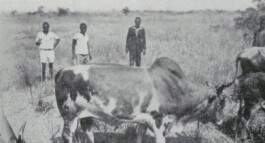


The Katanga province is, until this day, primarily known for its extensive mining activities, which are well-documented in existing literature. However, the intertwined history of cattle farming, beef production, and dairy farming in this area has received less attention. From the 1920s onwards, large-scale ranching enterprises began to emerge with the primary goal of supplying food to the growing workforce of African labourers and European employees in Katanga’s mining industry, as well as the expanding settler population. Around the same time, smaller European farmers around Lubumbashi started to focus on milk and butter production for the urban population.
To investigate the social transformations and ecological impacts of the expanding cattle industry in Katanga this research draws on a wide range of sources, including archival records, visual material, and interviews collected through extensive fieldwork. By integrating sources from different actors, this study aims to reconstructs the key decisions, policies, and actions that sought to transform Katanga into a profitable cattle production region. The ecological impacts of this expanding industry will be carefully examined. Additionally, the role and agency of non-humans, including cattle, predators, and insects, in shaping these transformations will be thoroughly investigated. The research will also pay attention to the people who lived and worked in these newly established cattle ranching regions. It will analyse how local communities, labourers, and various social groups interacted with and responded to this industry.
This research covers the period from the early 20th century to the late 1970s, tracing the long-term processes of the expanding cattle industry. Through a combination of perspectives from social and environmental history and experiences of multiple actors, this research will offer a comprehensive and nuanced understanding of Katanga’s cattle industry.


The Katanga province is, until this day, primarily known for its extensive mining activities, which are well-documented in existing literature. However, the intertwined history of cattle farming, beef production, and dairy farming in this area has received less attention. From the 1920s onwards, large-scale ranching enterprises began to emerge with the primary goal of supplying food to the growing workforce of African labourers and European employees in Katanga’s mining industry, as well as the expanding settler population. Around the same time, smaller European farmers around Lubumbashi started to focus on milk and butter production for the urban population.
To investigate the social transformations and ecological impacts of the expanding cattle industry in Katanga this research draws on a wide range of sources, including archival records, visual material, and interviews collected through extensive fieldwork. By integrating sources from different actors, this study aims to reconstructs the key decisions, policies, and actions that sought to transform Katanga into a profitable cattle production region. The ecological impacts of this expanding industry will be carefully examined. Additionally, the role and agency of non-humans, including cattle, predators, and insects, in shaping these transformations will be thoroughly investigated. The research will also pay attention to the people who lived and worked in these newly established cattle ranching regions. It will analyse how local communities, labourers, and various social groups interacted with and responded to this industry.
This research covers the period from the early 20th century to the late 1970s, tracing the long-term processes of the expanding cattle industry. Through a combination of perspectives from social and environmental history and experiences of multiple actors, this research will offer a comprehensive and nuanced understanding of Katanga’s cattle industry.


This website is part of and supported by the ERC Starting Grant CATTLEFRONTIERS, Grant No. 101076565 funded by the European Union.
Views and opinions expressed are however those of the author(s) only and do not necessarily reflect those of the European Union or the European Research Council Executive Agency. Neither the European Union nor the granting authority can be held responsible for them.
This website is created by: Kasper Jacek, using Lay Theme, Lora by Cyreal & Archivo Black by Omnibus-Type, licensed under Open Font License.
If nothing else is stated all material on this website is owned by the CATTLEFRONTIERS. Any archival material is used with the permission of the archives. For a complete list of copyrights for the archival material used on this website see Copyright – please contact us for permission to use any of the material on this website.
We don't store any personal data on this website.


This website is part of and supported by the ERC Starting Grant CATTLEFRONTIERS, Grant No. 101076565 funded by the European Union.
Views and opinions expressed are however those of the author(s) only and do not necessarily reflect those of the European Union or the European Research Council Executive Agency. Neither the European Union nor the granting authority can be held responsible for them.
This website is created by: Kasper Jacek, using Lay Theme, Lora by Cyreal & Archivo Black by Omnibus-Type, licensed under Open Font License.
We don't collect any personal data on this website.